When people research a stock before trading or investing, they often come across two major approaches: technical analysis and fundamental analysis.
Technical analysis mainly studies price movements, charts, and trading activity, while fundamental analysis examines the financial health, business performance, and underlying value of an asset or company.
Both approaches can be useful, but they answer different questions. Understanding the difference can help traders and investors decide which type of analysis fits their strategy.
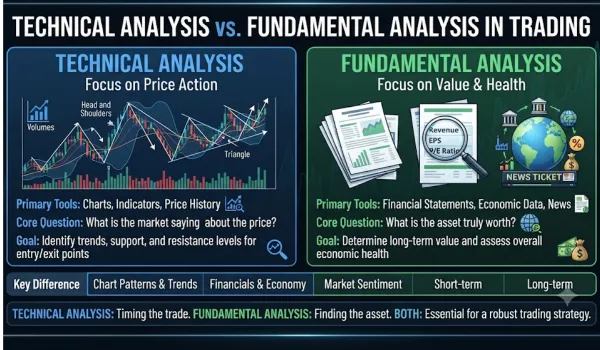
What Is Technical Analysis?
Technical analysis is a method of studying historical price and trading data to identify patterns, trends, and potential future price movements.
Technical analysts generally believe that market activity can provide useful information about possible price behavior.
They commonly study:
- Price charts
- Trading volume
- Support and resistance
- Trends
- Moving averages
- Momentum indicators
- Chart patterns
- Volatility
Example of Technical Analysis
Suppose a stock has repeatedly struggled to move above ₹500 but has found support around ₹450.
A technical trader may study this price behavior and look for signals suggesting whether the stock could break above ₹500 or fall below ₹450.
The analysis is primarily based on market price and trading data, rather than the company’s financial statements.
What Is Fundamental Analysis?
Fundamental analysis evaluates the underlying financial and economic factors that may affect the value of an asset.
For stocks, a fundamental analyst may examine:
- Revenue
- Profit
- Earnings per share
- Debt
- Cash flow
- Assets and liabilities
- Business model
- Management
- Industry conditions
- Competitive position
- Growth prospects
The objective is generally to understand whether a company’s current market price appears reasonable compared with its underlying business and future prospects.
Example of Fundamental Analysis
Suppose a company’s stock is trading at ₹500.
An investor may study the company’s revenue growth, profitability, debt, cash flow, industry position, and future plans before deciding whether the stock appears attractive at that price.
The focus is on the business and its underlying value.
Technical vs. Fundamental Analysis: Key Differences
| Factor | Technical Analysis | Fundamental Analysis |
| Main focus | Price and trading activity | Business and financial performance |
| Primary tools | Charts and indicators | Financial statements and business data |
| Time horizon | Often short to medium term | Often medium to long term |
| Key question | What might the price do next? | What may the asset be worth? |
| Company financials | Usually less important | Very important for stocks |
| Market trends | Highly important | Considered but not the sole focus |
| Trading volume | Commonly analyzed | Usually less central |
| Common users | Traders | Investors and long-term market participants |
How Technical Analysis Works
Technical analysts look for patterns and signals that may indicate a potential change in price direction.
Trends
A stock may show an upward, downward, or sideways trend.
Traders may use trend analysis to decide whether they want to consider buying, selling, or waiting.
Support and Resistance
Support is a price area where buying interest may help prevent further declines.
Resistance is a price area where selling pressure may limit further increases.
These levels are not guaranteed barriers. Prices can move through them when market conditions change.
Moving Averages
Moving averages smooth historical price data to help traders identify trends.
Different traders use different time periods depending on their strategy.
Trading Volume
Volume measures the amount of an asset traded during a particular period.
Changes in volume may provide additional information when studied alongside price movements.
How Fundamental Analysis Works
Fundamental analysis focuses on the factors that influence an asset’s underlying value.
Financial Statements
For a company, analysts may review:
- Income statements
- Balance sheets
- Cash-flow statements
These can provide insight into profitability, financial strength, debt, and cash generation.
Earnings and Revenue
Consistent revenue and earnings growth may indicate a healthy business, although past performance does not guarantee future results.
Debt
A company’s debt level can affect financial stability, especially when interest rates are high or business conditions weaken.
Industry and Competition
A company should not always be analyzed in isolation.
Industry growth, competition, regulation, customer demand, and broader economic conditions can all affect future performance.
Which Analysis Is Better?
There is no universal winner.
The better approach depends on what you are trying to achieve.
Technical Analysis May Be More Useful When:
- You are focused on short-term price movements
- You need potential entry and exit points
- You actively trade market trends
- You want to study price momentum
- You are working with shorter time frames
Fundamental Analysis May Be More Useful When:
- You are evaluating a company for long-term investment
- You want to understand the underlying business
- You are comparing companies
- You are studying financial strength
- You are assessing long-term growth prospects
Can You Use Both?
Yes. Many market participants use both technical and fundamental analysis.
For example, an investor may first use fundamental analysis to identify financially strong companies and then use technical analysis to study potential entry points.
This approach can provide two different perspectives:
Fundamental analysis:
“Is this business or asset attractive?”
Technical analysis:
“What is the market price doing, and what could happen next?”
However, using both methods does not eliminate investment risk.
Technical Analysis vs. Fundamental Analysis for Different Trading Styles
Day Trading
Day traders often rely heavily on technical analysis because their positions are held for short periods.
They may focus on:
- Price movements
- Volume
- Momentum
- Intraday charts
- Support and resistance
Swing Trading
Swing traders may also rely heavily on technical analysis but may incorporate company news and broader market information.
Position Trading
Position traders may combine technical and fundamental analysis because their positions can remain open for months or longer.
Long-Term Investing
Long-term investors often place greater emphasis on fundamental analysis, particularly when evaluating individual companies.
Limitations of Technical Analysis
Technical analysis has limitations.
Historical price patterns do not guarantee future results. Market prices can be affected by unexpected news, economic developments, company announcements, and investor sentiment.
A pattern that worked previously may not work under different market conditions.
Limitations of Fundamental Analysis
Fundamental analysis also has limitations.
Financial statements describe past and current performance, but future business conditions are uncertain.
A company can appear financially strong and still experience:
- Falling demand
- Increased competition
- Regulatory changes
- Management problems
- Economic difficulties
A stock can also remain overvalued or undervalued for longer than expected.
A Simple Example
Imagine two traders are looking at the same company.
Trader A — Technical Approach
They study the stock chart and notice that the price has been making higher highs and higher lows. They use this information to assess the current trend.
Trader B — Fundamental Approach
They study the company’s revenue, profits, debt, cash flow, industry position, and future growth prospects.
Both traders are studying the same stock but asking different questions.
Frequently Asked Questions
Is technical analysis better than fundamental analysis?
No. They serve different purposes. Technical analysis focuses mainly on price and trading activity, while fundamental analysis focuses on the underlying business and financial factors.
Do professional traders use fundamental analysis?
Some do, while others rely mainly on technical or quantitative methods. The approach varies by trader, market, strategy, and time horizon.
Is fundamental analysis better for beginners?
It can be useful for beginners who want to understand how a business works and evaluate its financial position. However, beginners should learn the limitations of financial analysis as well.
Can technical analysis predict stock prices?
Technical analysis can help identify patterns and potential scenarios, but it cannot reliably guarantee where a stock price will move.
Can I use technical and fundamental analysis together?
Yes. Combining the two can provide different perspectives on the same asset, although it does not remove market risk.
Final Takeaway
Technical analysis and fundamental analysis look at markets from different angles.
Technical analysis focuses on price, charts, volume, trends, and market behavior, while fundamental analysis focuses on financial performance, business quality, valuation, and long-term prospects.
For short-term trading, technical analysis may be more relevant. For long-term stock evaluation, fundamental analysis often plays a larger role. Many traders and investors also combine both approaches.
Ultimately, no analysis method can guarantee profits. A sound strategy should also consider risk management, trading costs, market conditions, and your own financial circumstances.
This article is for general informational and educational purposes only and should not be considered financial or investment advice.
About the Author