Buying a home, flat, villa or plot is a major financial commitment. Most buyers expect the developer, builder or property management team to resolve routine concerns through customer care. However, some problems may continue even after repeated follow-ups.
This is where real estate complaint escalation becomes important.
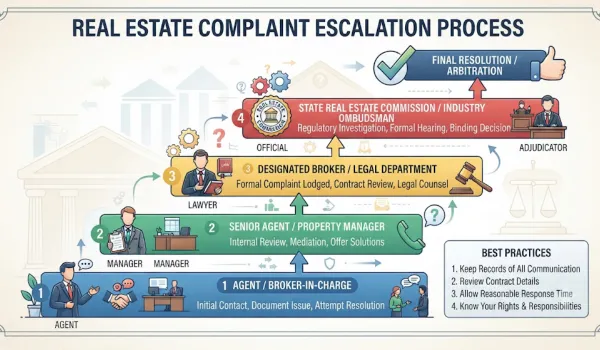
Escalation means taking a complaint to a higher level when the first point of contact does not provide a satisfactory response. Depending on the problem, the next step may involve senior management, a formal grievance process, a regulatory authority or another appropriate dispute-resolution forum.
Understanding when and how to escalate a property complaint can help buyers protect their interests and maintain a proper record of the dispute.
What Is Real Estate Complaint Escalation?
Real estate complaint escalation is the process of moving a property-related complaint from a normal customer-care channel to a higher authority.
For example, a buyer may first contact the developer’s customer-care team about a delayed possession. If the issue is not resolved, the buyer may submit a formal complaint to the developer’s grievance department. If there is still no satisfactory resolution, the buyer can consider the appropriate external authority or legal remedy.
Escalation does not always mean immediately filing a legal case. A structured approach can often help resolve the issue more efficiently.
When Should a Buyer Escalate a Complaint?
Not every minor issue needs immediate escalation.
You may consider escalation when:
- Customer care does not respond.
- Repeated complaints remain unresolved.
- A promised correction has not been completed.
- Possession is delayed.
- A refund is not processed as expected.
- Payment records appear incorrect.
- Construction defects remain unresolved.
- You receive an unexpected or disputed demand.
- The property differs from applicable contractual commitments.
- A formal notice or serious dispute has arisen.
Before escalating, check the relevant agreement and maintain evidence of your previous communication.
Common Real Estate Complaints
Property buyers may face a wide range of issues.
| Complaint | Possible First Step |
| Possession delay | Contact developer customer care |
| Payment mismatch | Request account reconciliation |
| Construction defect | Submit written repair request |
| Refund delay | Ask for refund status in writing |
| Unexpected charges | Request detailed calculation |
| Incorrect unit details | Request correction |
| Missing documents | Contact project/customer-care team |
| Poor maintenance | Raise service complaint |
| Unresolved complaint | Escalate to senior management |
The appropriate solution depends on the facts, agreement and applicable law.
Start With the Developer
The first step should generally be to contact the developer or builder.
Use the appropriate customer-care channel and clearly explain the issue.
Include:
- Project name
- Unit number
- Customer ID
- Booking number
- Date of transaction
- Description of the problem
- Relevant documents
- Resolution requested
For important matters, submit the complaint in writing.
Ask for a Complaint Reference Number
A complaint reference number is important for follow-up.
After submitting your complaint, ask for:
- Complaint number
- Date of registration
- Department handling the issue
- Expected response timeline
When you follow up, refer to the same complaint number.
This prevents you from having to explain the entire issue repeatedly.
Give the Developer a Reasonable Opportunity to Respond
Before moving to a higher authority, allow the developer reasonable time to investigate the complaint, unless the matter is urgent or involves a formal deadline.
Keep a record of:
- Complaint date
- Response received
- Promises made
- Follow-up dates
- Documents submitted
If the developer gives a specific resolution date and does not meet it, mention that date in your escalation.
Escalate to Senior Management
If customer care does not resolve the matter, ask for the next level of escalation.
Depending on the organisation, this may be:
- Customer-care manager
- Project head
- Senior management
- Grievance officer
- Nodal officer
- Corporate office
Your escalation should refer to the original complaint.
Example
“My complaint was registered under reference ABC123 on 10 August. Despite repeated follow-ups, the issue remains unresolved. I request that the matter be escalated to the appropriate senior authority.”
Keep the tone professional and factual.
Prepare Your Documents Before Escalating
A well-organised complaint is easier to understand.
Keep these documents ready:
- Booking form
- Allotment letter
- Sale agreement
- Payment receipts
- Bank statements
- Demand letters
- Possession communications
- Emails
- Complaint references
- Photographs
- Inspection reports
- Other relevant correspondence
Do not submit unnecessary personal documents.
Build a Timeline of the Dispute
A timeline can make a complicated property complaint much clearer.
| Event | Date |
| Booking made | ______ |
| Agreement signed | ______ |
| Payment made | ______ |
| Expected possession | ______ |
| Problem reported | ______ |
| First complaint | ______ |
| Developer response | ______ |
| Follow-up | ______ |
| Escalation | ______ |
This is particularly useful for long-running complaints.
Escalating a Possession Delay
Possession delays are among the most important complaints in real estate.
If your property has not been delivered within the applicable contractual or regulatory timeline, collect:
- Agreement
- Possession clause
- Payment records
- Construction updates
- Previous correspondence
- Developer’s latest statement
Ask the developer to provide a written explanation and current project status.
Depending on the project and applicable law, buyers may have certain remedies for delay.
Escalating Construction Defects
If you find construction defects after possession or during inspection, first notify the developer in writing.
Document:
- Nature of the defect
- Location
- Date discovered
- Photographs
- Previous repair requests
- Developer’s response
If the defect remains unresolved, escalate the matter and retain all evidence.
For significant technical concerns, an independent professional inspection may also be useful.
Escalating a Refund Dispute
If you are waiting for a refund, check the relevant cancellation terms and payment records.
Your complaint should mention:
- Amount paid
- Cancellation date
- Refund request date
- Applicable terms
- Amount expected
- Amount received, if any
- Outstanding amount
Ask for a written refund status and expected processing date.
Escalating an Incorrect Demand
If a developer asks you to pay an amount that you do not understand, request a detailed statement.
Ask for:
- Nature of the charge
- Calculation
- Agreement clause
- Tax component
- Due date
- Supporting document
Do not automatically accept a disputed demand simply because it appears on a payment notice.
At the same time, do not stop contractual payments without understanding the possible consequences.
When Can a Regulatory Authority Become Relevant?
If internal complaints fail, the appropriate real estate regulatory authority may be relevant for eligible projects and disputes.
In India, the Real Estate (Regulation and Development) Act, 2016 provides a regulatory framework for applicable real estate projects and transactions.
State and Union Territory authorities administer the applicable regulatory system.
Potential issues may include matters relating to:
- Project registration
- Promoter obligations
- Possession
- Project information
- Buyer rights
- Certain contractual disputes
- Refund or interest-related claims
The exact remedy depends on the facts and applicable provisions.
RERA Complaint Process
For a project covered by the applicable RERA framework, buyers should first identify the relevant state or Union Territory authority.
Before filing, keep ready:
- Buyer details
- Developer details
- Project information
- Unit number
- Registration information, where applicable
- Agreement
- Payment records
- Complaint correspondence
- Supporting evidence
- Relief requested
Check the applicable authority’s current filing requirements before submitting a complaint.
Other Possible Dispute-Resolution Options
Not every real estate dispute follows the same route.
Depending on the circumstances, buyers may need to consider:
- Real estate regulatory authority
- Adjudicating mechanism where applicable
- Consumer dispute-resolution forum
- Civil court
- Arbitration, if applicable under the agreement
- Other legally available remedies
The correct forum can depend on the nature of the dispute, the agreement and applicable law.
For substantial disputes, professional legal advice may be appropriate.
Write a Strong Escalation Complaint
A good escalation letter should be short, factual and supported by documents.
Sample Format
Subject: Escalation of Real Estate Complaint – [Project Name], Unit [Number]
Dear Sir/Madam,
I am writing to escalate my complaint regarding [briefly state the issue].
My property details are:
- Project: [Project Name]
- Unit: [Unit Number]
- Booking/Customer ID: [Number]
- Agreement Date: [Date]
The original complaint was submitted on [date] under reference [number]. Despite follow-ups on [dates], the matter remains unresolved.
The issue is [brief description].
I request that the matter be reviewed by the appropriate senior authority and that I receive a written response regarding the proposed resolution.
Please acknowledge this escalation and provide the applicable reference number.
Regards,
[Name]
[Contact Details]
What Buyers Should Not Do
Do Not Rely Only on Phone Calls
Important matters should also be documented.
Do Not Delete Old Communication
Previous emails and messages may become important evidence.
Do Not Make False Claims
Keep your complaint limited to facts you can support.
Do Not Ignore Formal Notices
A notice from the developer should be reviewed promptly.
Do Not Share OTPs
No genuine complaint process should require you to disclose confidential authentication credentials.
Do Not Make Major Decisions Without Understanding the Agreement
Stopping payments, cancelling a booking or signing a settlement can have significant consequences.
How to Follow Up After Escalation
Follow-up should be systematic rather than repetitive.
When contacting the developer, mention:
- Original complaint number
- Escalation number
- Previous communication date
- Current status
- Pending action
If the developer has promised a specific action by a particular date, mention whether that deadline has passed.
Keep a Complete Complaint File
Create a dedicated digital or physical folder for the dispute.
Include:
Property Documents
Booking form, allotment letter and agreement.
Financial Records
Receipts, bank statements and demand letters.
Communication
Emails, letters and complaint references.
Evidence
Photographs, videos, inspection reports and notices.
Timeline
Dates of all major events and follow-ups.
This organisation can be extremely helpful if the matter moves to a formal forum.
Common Questions
What does real estate complaint escalation mean?
It means moving a property complaint from the normal customer-care level to a senior management, grievance, regulatory or other appropriate dispute-resolution level when the issue remains unresolved.
Should I contact the developer before filing a formal complaint?
For many routine disputes, it is sensible to first give the developer an opportunity to resolve the issue. Keep written evidence of your complaint and follow-ups.
Can I escalate a delayed possession complaint?
Yes. First collect your agreement, payment records and previous correspondence and raise the matter with the developer. Depending on the project and applicable law, further remedies may be available.
What documents are important during complaint escalation?
The booking form, agreement, allotment letter, payment records, demand letters, emails, complaint references, photographs and other evidence relevant to the dispute are commonly useful.
What if the developer still does not resolve my complaint?
After completing the applicable internal escalation process, you can consider the appropriate regulatory, consumer, arbitration or legal mechanism depending on the nature of the dispute and applicable law.
Final Words
Real estate complaint escalation should be approached in a structured and documented manner. Start by clearly explaining the problem to the developer and keep the complaint reference number. If customer care does not resolve the issue, escalate it to the appropriate senior or grievance team.
For serious disputes, organise your agreement, payment records, correspondence and other evidence before approaching an external authority or forum. For applicable projects, the relevant real estate regulatory framework may provide an additional complaint mechanism.
Most importantly, keep everything in writing, follow the applicable process and understand your contractual and legal position before taking major action.