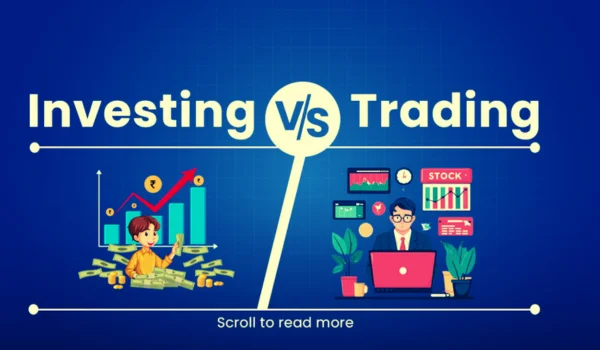
Trading and investing both involve putting money into financial assets with the expectation of earning a return. However, the two approaches are very different in terms of time horizon, decision-making, risk management, and objectives.
A trader usually focuses on shorter-term price movements, while an investor generally focuses on the longer-term value and growth of an asset.
Understanding the difference can help you choose an approach that better fits your financial goals and risk tolerance.
What Is Trading?
Trading involves buying and selling financial assets with the goal of benefiting from price movements.
A trader may hold an asset for:
- Minutes
- Hours
- Days
- Weeks
- Sometimes months
The focus is generally on identifying opportunities created by changes in market prices.
Traders may use tools such as price charts, trading volume, technical indicators, market news, and other market information to make decisions.
Common Types of Trading
Some common trading approaches include:
- Intraday trading: Positions are generally opened and closed during the same trading session.
- Swing trading: Positions may be held for several days or weeks.
- Short-term trading: Focuses on relatively quick price movements.
- Position trading: Positions may be held for longer periods while still focusing primarily on market price trends.
What Is Investing?
Investing generally involves purchasing an asset with the intention of holding it for a longer period.
An investor may hold an investment for:
- Several months
- Several years
- Decades
The focus is often on the long-term potential of the investment rather than short-term price fluctuations.
For example, a person investing in shares may study a company’s revenue, profits, debt, business model, management, competitive position, and future growth prospects before buying its stock.
Trading vs. Investing: Key Differences
| Factor | Trading | Investing |
| Main focus | Short-term or medium-term price movements | Long-term growth and value |
| Typical holding period | Minutes to months | Usually years or longer |
| Decision-making | Often based heavily on market movements and price trends | Often based on fundamentals and long-term prospects |
| Trading frequency | Generally higher | Generally lower |
| Market monitoring | Often frequent | Usually less frequent |
| Short-term volatility | Very important | Often less important to the overall strategy |
| Time commitment | Can be high | Usually lower after initial research |
| Objective | Capture price movements | Build wealth over time |
Trading vs. Investing: How the Mindset Differs
The biggest difference is often the way the market is viewed.
A Trader Thinks About Price
A trader may ask:
“Where could the price move next?”
The focus is often on market momentum, trends, support and resistance levels, volume, and other short-term factors.
An Investor Thinks About Value
An investor may ask:
“What could this asset be worth several years from now?”
The focus may be on the underlying business, earnings, growth prospects, valuation, and long-term economic conditions.
Neither approach is automatically superior. They simply involve different objectives and methods.
Risk: Trading vs. Investing
Both trading and investing carry financial risk.
Risks of Trading
Trading can involve:
- Rapid price movements
- Frequent losses
- Emotional decision-making
- Higher transaction costs from frequent activity
- The risk of taking excessive positions
- Significant losses from poor risk management
Short-term market movements can be difficult to predict consistently.
Risks of Investing
Long-term investing also involves risk.
An investment can lose value because of:
- Poor company performance
- Economic conditions
- Industry problems
- Changes in regulations
- Market downturns
- Business failures
Holding an asset for a long time does not guarantee a profit.
Which Requires More Time?
Generally, trading requires more active involvement.
A trader may need to monitor the market regularly and make decisions quickly.
An investor may spend considerable time researching an investment before purchasing it but may not need to monitor every price movement afterward.
However, the amount of time required depends on the individual’s strategy.
Example: Trading
Suppose a stock is trading at ₹500.
A trader purchases the stock at ₹500 and sells it at ₹520 a few days later.
The gross price difference is:
₹20 per share
If the trader purchased 100 shares, the gross gain from the price movement would be:
₹20 × 100 = ₹2,000
This example does not account for brokerage, taxes, other charges, or possible losses.
Example: Investing
An investor purchases shares of a company at ₹500 after researching its business and long-term prospects.
The investor holds the shares for several years.
If the company’s business performs well and the stock eventually reaches ₹750, the investor may benefit from the increase in value.
However, the price could also fall, and there is no guarantee that the investment will be profitable.
Trading vs. Investing: Which Is Better?
There is no universal answer.
Trading may be more appropriate for someone who:
- Understands market risks
- Has time to monitor markets
- Can manage short-term losses
- Understands trading strategies
- Has strong risk-management discipline
Investing may be more appropriate for someone who:
- Has long-term financial goals
- Wants to build a portfolio over time
- Is willing to tolerate market fluctuations
- Prefers less frequent buying and selling
- Wants to focus on long-term asset growth
Your financial situation, knowledge, goals, and risk tolerance should all be considered.
Can Someone Both Trade and Invest?
Yes.
A person can maintain a long-term investment portfolio while also engaging in trading with a separate portion of their capital.
However, it is important to understand that the two activities involve different strategies and risk-management requirements.
Keeping clear records and maintaining separate objectives can help avoid confusing short-term trading decisions with long-term investment decisions.
Trading vs. Investing and Taxes
The tax treatment of trading and investing can differ depending on the asset, transaction type, holding period, and applicable tax rules.
For example, in India, the tax treatment of different types of stock-market income can depend on how the transaction is classified under the applicable rules.
Because tax laws and rates can change, investors and traders should verify the current tax provisions or consult a qualified tax professional when making decisions based on taxation.
A Simple Way to Remember the Difference
Think of it this way:
Trading = Focus on price movement.
Investing = Focus on long-term value and growth.
A trader is generally trying to benefit from when to buy and sell, while an investor is generally more concerned with what they own and how it may perform over time.
Frequently Asked Questions
Is trading the same as investing?
No. Both involve financial assets, but trading generally focuses on shorter-term price movements, while investing usually focuses on longer-term growth and value.
Is trading riskier than investing?
Trading can involve significant short-term risks, but investing also carries the possibility of substantial losses. The level of risk depends on the asset, strategy, position size, and market conditions.
Is investing better for beginners?
Long-term investing may be easier for some beginners to understand and manage than active trading, but beginners should still learn about market risks before investing.
Can I trade and invest at the same time?
Yes. Some people use separate portions of their capital for long-term investments and active trading.
Which makes more money, trading or investing?
Neither guarantees a particular return. Results depend on the strategy, asset selection, timing, costs, risk management, and market performance.
Final Takeaway
Trading and investing are two different approaches to participating in financial markets.
Trading generally focuses on shorter-term price movements, while investing focuses more on long-term value and growth. Trading may require more frequent decisions and market monitoring, whereas investing often involves a longer-term perspective.
Before choosing either approach, consider your financial goals, risk tolerance, experience, available time, and ability to handle losses.
This article is provided for general informational and educational purposes only and should not be considered financial or investment advice.
About the Author