The terms customer service and customer support are often used as if they mean the same thing. Both involve helping customers, but there is an important difference between them.
Customer service generally covers the broader customer experience. Customer support is usually more focused on solving specific problems, especially technical, product or account-related issues.
Understanding customer service vs customer support can help customers know whom to contact and help businesses organise their support teams more effectively.
What Is Customer Service?
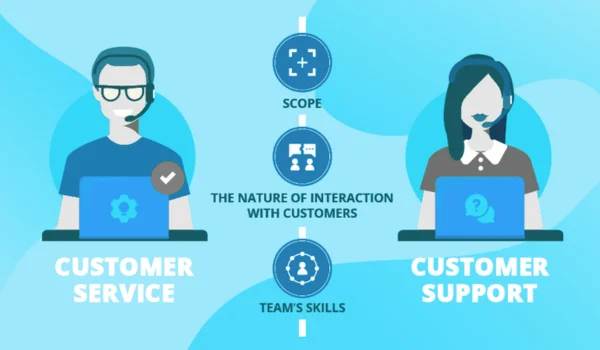
Customer service refers to the overall assistance a company provides to customers before, during and after a purchase.
It can include answering questions, helping with orders, handling complaints, explaining policies and assisting customers with general concerns.
Customer service may involve:
- Product information
- Order assistance
- Returns and refunds
- Billing questions
- Complaints
- Account assistance
- General enquiries
- Delivery information
- Service information
- Customer feedback
The main purpose is to provide a smooth and positive customer experience.
What Is Customer Support?
Customer support is generally more focused on resolving a particular customer problem.
It is especially common in industries where customers may need technical or product assistance.
Customer support may deal with:
- Technical problems
- Product errors
- Software issues
- Account access problems
- Installation difficulties
- Device problems
- Service interruptions
- Troubleshooting
- Product configuration
For example, if a customer cannot log into an application, the issue may be handled by customer support rather than general customer service.
Customer Service vs Customer Support: Quick Difference
The simplest way to understand the difference is:
Customer service = broader assistance and customer experience
Customer support = specific problem-solving and troubleshooting
| Factor | Customer Service | Customer Support |
| Main focus | Overall customer experience | Solving specific problems |
| Scope | Broad | More specialised |
| Common questions | General and transaction-related | Product, technical or account issues |
| Main goal | Customer satisfaction | Problem resolution |
| Typical interaction | Questions, complaints, returns | Troubleshooting and technical assistance |
| Knowledge required | Product, policy and process knowledge | Deeper product or technical knowledge |
| Common channels | Phone, chat, email, in-person | Chat, phone, email, ticket systems |
| Example | Asking about a return | Fixing a product or software problem |
How Customer Service Works
Customer service often begins when a customer has a question or needs assistance.
For example, a customer may ask:
- When will my order arrive?
- Can I return this product?
- How can I change my billing details?
- What is the refund policy?
- Can I cancel my order?
- Where can I find my invoice?
The customer-service team identifies the issue and either resolves it or directs the customer to the appropriate department.
Customer service therefore acts as an important connection between the customer and the company.
How Customer Support Works
Customer support usually starts when something is not working correctly.
For example:
Customer: “I installed the software, but it keeps showing an error.”
The support team may then:
- Identify the problem
- Ask troubleshooting questions
- Check the customer’s account or product
- Provide instructions
- Suggest a solution
- Escalate the issue if necessary
- Confirm whether the problem has been resolved
This makes customer support more problem-oriented than general customer service.
Is Customer Support a Part of Customer Service?
In many companies, customer support can be considered one part of the wider customer-service function.
A company may have a customer-service department handling general enquiries and a specialised customer-support team handling technical or product problems.
However, the exact structure varies between businesses.
Some companies use the terms interchangeably, while others maintain separate teams.
Examples of Customer Service
Imagine that you purchase a refrigerator.
You contact the company to ask:
“What is the delivery date for my order?”
This is generally a customer-service question.
Another example is:
“I want to cancel my order. What is the cancellation process?”
This is also generally handled by customer service.
Customer service focuses on helping you navigate the company’s products, policies and processes.
Examples of Customer Support
Now imagine that the refrigerator has been delivered but is not cooling properly.
You contact the company and explain the problem.
The representative may ask:
- When was the product installed?
- Is the appliance receiving power?
- Is there an error indication?
- What temperature is displayed?
- Have you tried restarting the appliance?
This is more closely related to customer support because the goal is to diagnose and resolve a specific product problem.
Customer Service vs Customer Support in E-Commerce
Online shopping companies often use both functions.
Customer service may handle:
- Order status
- Returns
- Refunds
- Delivery questions
- Payment queries
- Cancellation requests
Customer support may handle:
- Product setup
- Technical issues
- Account problems
- Device troubleshooting
- Software-related issues
For a simple delivery question, customer service may be enough. For a technical product problem, customer support may be more appropriate.
Customer Service vs Customer Support in Software Companies
Software companies often have a clear distinction between the two.
Customer service may help with:
- Subscription information
- Billing
- Account changes
- Plan upgrades
- General product questions
Customer support may handle:
- Login errors
- Software bugs
- Integration problems
- Technical configuration
- Data-related issues
- Application errors
Technical support employees generally need deeper knowledge of the company’s software and systems.
What Is the Difference in Skills?
Customer-service representatives need strong communication and people skills.
Important customer-service skills include:
- Communication
- Patience
- Listening
- Empathy
- Product knowledge
- Problem identification
- Complaint handling
Customer-support representatives may require many of the same skills but often need additional technical knowledge.
Important customer-support skills may include:
- Troubleshooting
- Technical understanding
- Product expertise
- Analytical thinking
- Problem diagnosis
- Clear technical communication
Both roles require good communication because customers need explanations that are easy to understand.
Which One Is More Important?
Neither customer service nor customer support is automatically more important.
They serve different purposes.
A company can have an excellent technical-support team but still provide a poor customer experience if customers cannot get basic questions answered.
Similarly, a friendly customer-service team cannot provide a complete experience if serious product problems are not resolved efficiently.
A strong company needs both.
Customer Service and Customer Support Work Together
In many situations, customer service and customer support may work together.
For example:
A customer contacts customer service because a product is not working.
The customer-service representative identifies that the issue is technical and transfers or escalates the case to customer support.
The support team investigates the problem and provides a solution.
After the technical issue is resolved, customer service may help with follow-up, replacement or other administrative requirements.
This creates a complete support journey.
Which Department Should You Contact?
Choosing the right department can save time.
Contact Customer Service When:
- You have a general question.
- You need order information.
- You want to understand a return policy.
- You need help with a refund.
- You have a billing question.
- You want to make a cancellation request.
- You want to submit general feedback.
Contact Customer Support When:
- A product is not working.
- You have a technical problem.
- Software is showing an error.
- You cannot access an account.
- You need troubleshooting assistance.
- A device requires technical guidance.
- A service is not functioning as expected.
If you are unsure, start with general customer service. The representative can usually direct you to the appropriate team.
Customer Service vs Customer Support vs Technical Support
These terms can sometimes overlap.
| Term | Main Purpose |
| Customer Service | Overall customer assistance |
| Customer Support | Solving specific customer problems |
| Technical Support | Resolving technical or system-related problems |
Technical support is often a specialised form of customer support.
For example, an internet company may have customer service for billing and plans, while technical support handles connectivity and equipment problems.
How Businesses Can Improve Both Functions
Companies should not treat customer service and customer support as completely separate experiences.
A customer does not care which internal department solves the problem. They mainly want a clear and effective solution.
Businesses can improve both functions by:
- Providing clear contact options
- Training employees properly
- Keeping customer records organised
- Reducing unnecessary transfers
- Providing self-service information
- Creating clear escalation procedures
- Monitoring response times
- Collecting customer feedback
- Improving product documentation
- Following up on unresolved complaints
Good communication between departments is particularly important.
Common Questions
Is customer service the same as customer support?
No. They overlap, but customer service is generally broader and focuses on the overall customer experience, while customer support usually focuses on solving specific product, technical or account-related problems.
Is customer support only for technical problems?
No. Customer support can cover different types of problems, although technical and product-related issues are common.
Which department handles refunds?
Refunds are commonly handled by customer service or a specialised billing team. The exact department depends on the company.
Who should I contact for a product problem?
If the problem requires troubleshooting or technical assistance, customer support is usually the appropriate channel.
What should I do if I contact the wrong department?
Explain your problem clearly and ask the representative to direct or transfer you to the appropriate team. You normally do not need to start the entire process again without explanation.
Final Words
The main difference between customer service vs customer support is their focus.
Customer service is broader and deals with the overall customer experience, including questions, orders, returns, refunds, complaints and general assistance.
Customer support is more focused on solving specific problems, particularly technical, product and account-related issues.
In simple terms, customer service helps customers navigate their relationship with a company, while customer support helps customers solve problems.
For customers, knowing this difference can help them choose the right department and avoid unnecessary delays. For businesses, keeping both functions efficient is essential for building trust, retaining customers and providing a better overall experience.
About the Author